

Whether you are buying a house, moving to a new rental, or just tired of being locked into a plan that no longer suits you, the first question is usually the same: what broadband can I actually get here?
It sounds like a straightforward question. It is not. Ireland has several overlapping broadband networks – urban and rural, commercial and state-funded – and what you can get at one address can be completely different from what is available a few kilometres away. In rural areas especially, the difference can be substantial.
This guide walks you through exactly how to check, which tools to use, and what to do if the results are not what you were hoping for.
Start With the ComReg Broadband Checker
The best place to start is the Commission for Communications Regulation (ComReg), which is Ireland’s telecommunications regulator. ComReg runs a free, independent Broadband Checker at comreg.ie that shows all fixed broadband networks available at a given address – not just one provider’s offering.
You enter your Eircode or address, and if broadband is available, it shows you the network operator, the technology type (e.g. full fibre, cable, or fixed wireless), and the estimated speed range. It also lists the retail providers selling on each network, so you can see your options all in one place.
Because ComReg has no commercial interest in what you choose, this is the most neutral starting point. The four network operators currently listed in the ComReg checker are: NBI, Open eir, SIRO, and Virgin Media.
One thing worth knowing: the tool focuses on fixed broadband and does not cover mobile or satellite options. We will come back to those below.
Check Directly With the Main Network Operators
If you want more detail – or if ComReg shows limited results – it is worth checking directly with each of the major network operators. Here is what each one covers and how to use their tools.

Open eir – Ireland’s Largest Fibre Network
Open eir (openeir.ie) operates Ireland’s largest full fibre network, with a planned rollout of over 1.9 million homes and businesses. Their broadband checker at openeir.ie/fibre/broadband-checker lets you enter an Eircode to see if full fibre is already available or in progress at your address.
Open eir is a wholesale network, which means you cannot buy directly from them. Instead, you order service through a retail provider like eir, Sky, Vodafone, or several others who sell on the Open eir network. When you check your address on the Open eir site, it will show you which providers are currently selling in your area.
SIRO – Fibre Through the ESB Network
SIRO is a joint venture between ESB and Vodafone that delivers full fibre broadband using the ESB electricity infrastructure. It covers a growing list of towns and cities across Ireland and is worth checking separately, as it does not always appear with full detail on the ComReg tool.
Their address checker at siro.ie/search-your-address shows whether SIRO fibre is available at your specific property, along with a list of retail providers selling on their network – including Digiweb, Vodafone, Blacknight, and others. Prices and contract terms vary significantly between providers, so it is worth comparing before committing.
Virgin Media – Cable Broadband in Urban Areas
Virgin Media operates a cable network primarily in larger urban areas – Dublin, Cork, Galway, Limerick, Waterford, and their surrounding areas. Their coverage checker at virginmedia.ie will tell you quickly whether cable broadband is available. Where it is, speeds are generally strong, and Virgin Media is one of the only operators offering speeds up to 1 Gbps on a cable (rather than fibre) connection.
If you are in a larger town or city and Virgin Media is available, it is usually worth including them in your comparison.
NBI – The National Broadband Plan for Rural Ireland
If you live outside an urban area, this is the one to watch. National Broadband Ireland (NBI) is delivering the Government’s National Broadband Plan, which is rolling out full fibre broadband to approximately 564,000 homes, farms, and businesses that were not covered by commercial networks.
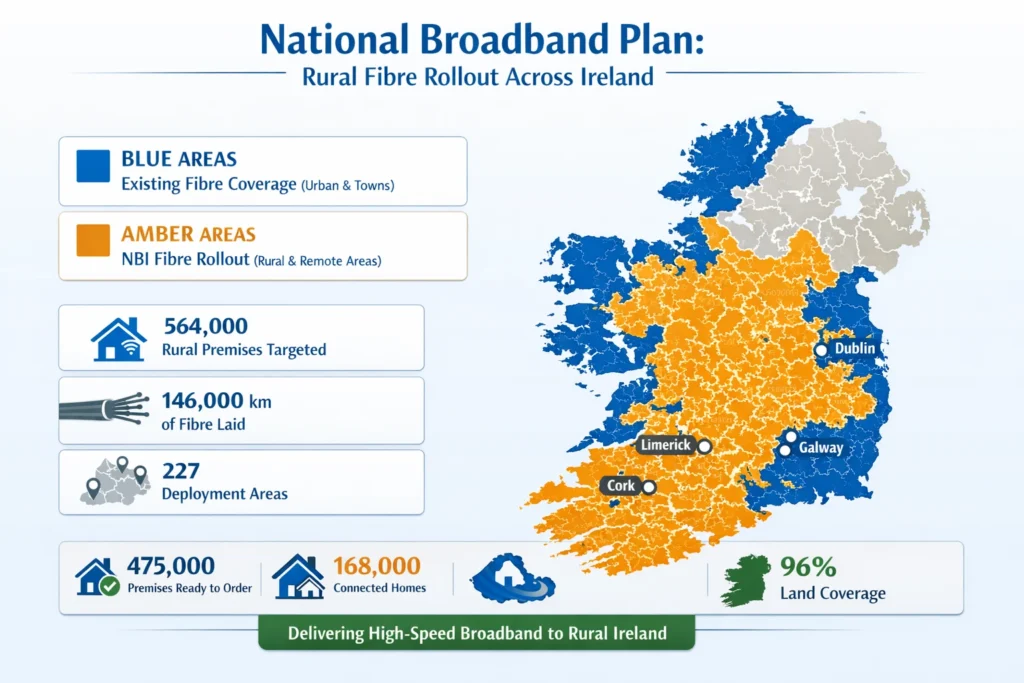
🇮🇪 National Broadband Plan – Fibre Rollout Overview (Concept Map)
As of mid-2025, NBI had passed over 400,000 premises – meaning fibre had been laid past the gate – with more than 140,000 already connected. Take-up rates are climbing, reaching close to 60% in areas where the network has been live the longest, such as rural parts of Mayo and Westmeath.
You can check your address on the NBI interactive map at nbi.ie. Enter your Eircode and it will tell you whether your premises is in the NBI intervention area, whether fibre has already been laid nearby, and – if not – an estimated timeline for when work is due to reach your area. You can also register your email address to receive updates when the rollout reaches you.
One important distinction: ‘passed’ does not mean ‘connected.’ It means the fibre infrastructure is in place and you can now order service from one of the 50-plus retail providers selling on the NBI network. Until you place an order and have an engineer install the connection, you are not connected.
Retail Providers – Vodafone, eir, Sky and Others
Alongside the network operators above, the major retail providers also have their own broadband availability checkers. Vodafone, eir, Sky, and Digiweb are among the most commonly used, and many people go to these first out of familiarity.
These tools are worth using – but with one important caveat. A retail provider’s checker only shows their own packages. Vodafone’s checker, for example, will tell you whether Vodafone can serve your address, but it will not tell you whether SIRO or NBI fibre is available nearby on a different network, potentially through a different provider.
This is not a criticism of any provider – it is just how the market works. Vodafone sells broadband over Open eir and SIRO infrastructure, not a network it owns itself. The same applies to Sky, eir (retail), Digiweb, and most others. They are resellers on top of the underlying networks.
The practical upshot: use ComReg’s checker first to get the full picture across all networks, then use a retail provider’s own checker when you are ready to compare packages and prices.
What the Results Actually Mean
Irish broadband listings use terminology that is not always explained clearly. Here are the key terms worth understanding before you sign up for anything.
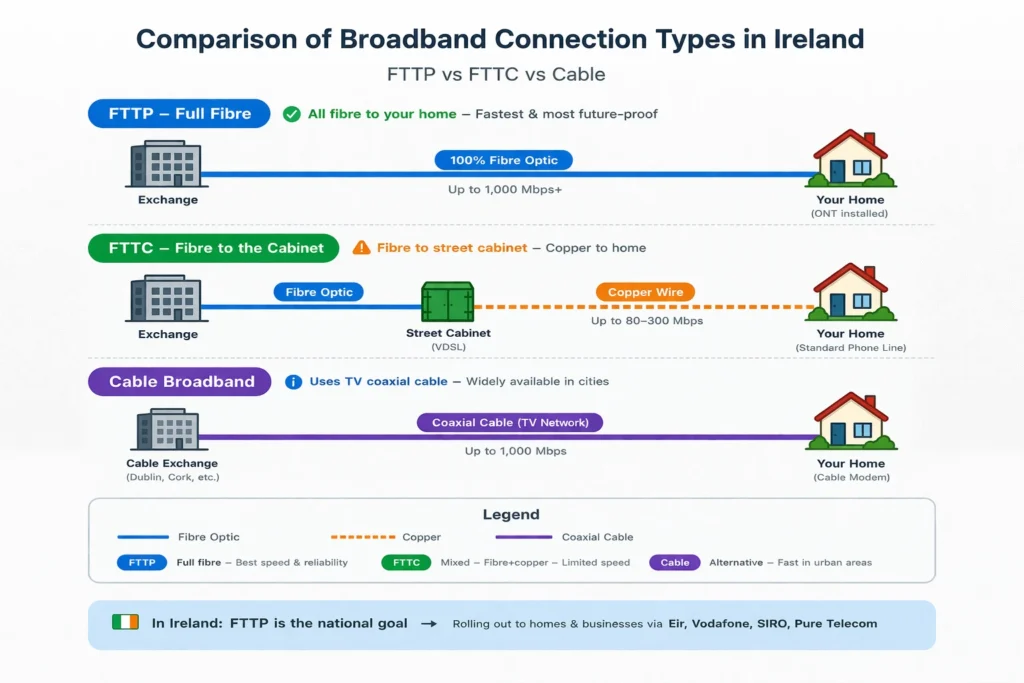
Full Fibre (FTTP – Fibre to the Premises): The fastest and most future-proof option. A fibre optic cable runs directly to your home. Available through Open eir, SIRO, and NBI. Supports speeds from 500 Mbps up to 5 Gbps in some areas.
Fibre to the Cabinet (FTTC): Older technology where fibre runs to a street cabinet, but the final stretch to your home uses older copper wiring. Speeds are slower and degrade with distance from the cabinet. Much less common now as full fibre expands.
Cable (DOCSIS): Used by Virgin Media. Not technically fibre, but cable infrastructure supports high speeds and has been reliable in urban areas.
Fixed Wireless Access (FWA): A radio signal rather than a physical cable. Sometimes used in areas not yet served by fibre. Speeds and reliability vary depending on terrain and distance from the transmitter.
What to Do If Nothing Is Available at Your Address
This still affects a meaningful number of Irish addresses – particularly rural ones where NBI construction has not yet reached. If that is your situation, you have a few realistic options.
Register with NBI for updates at nbi.ie. This is worth doing even if your area is still in the survey or design phase. Rollout is ongoing across all 26 counties and the expected completion date for the full intervention area is now 2026.
Consider Starlink. Elon Musk’s satellite broadband service launched in Ireland in 2021 and has become a practical option for rural homes. It delivers typical download speeds of 100 to 200 Mbps with lower latency than older satellite systems – around 20 to 50 milliseconds. The hardware costs roughly €300 upfront and monthly fees run around €50 to €65 depending on the plan. It is not cheap, but for homes with no other option, it is often worth it.
Check with local fixed wireless providers. Some smaller regional ISPs operate fixed wireless networks in rural areas that do not always appear on the national checkers. A search for broadband providers in your specific county or townland can sometimes surface options that the main tools miss.
A Note on Eircodes and Why They Matter
Every property in Ireland has a unique Eircode – a seven-character postcode – and when it comes to broadband, this is far more useful than a county name or town name. Two houses on the same road can be on completely different network infrastructures, especially near the boundaries between commercial and NBI intervention areas.
If you do not know your Eircode, you can look it up at eircode.ie using your address. It is worth having it to hand before you use any of the broadband checkers mentioned above.
Quick Summary: Where to Check
- ComReg Broadband Checker (comreg.ie/broadbandchecker): Best starting point. Neutral, covers all networks.
- Open eir Checker (openeir.ie/fibre/broadband-checker): Full fibre, urban and suburban Ireland.
- SIRO Checker (siro.ie/search-your-address): Full fibre in towns and cities via ESB infrastructure.
- NBI Map (nbi.ie): Rural Ireland only. Full fibre under the National Broadband Plan.
- Virgin Media (virginmedia.ie): Cable broadband in larger urban areas.
Checking takes less than five minutes and costs nothing. It is the one step worth doing before you contact any provider, compare any prices, or sign anything.
Conclusion
Ireland’s broadband landscape has improved enormously in recent years. Full fibre is now available to the majority of properties, and the NBI rollout is systematically closing the gap for rural homes and farms that were long left behind. But availability is still patchy enough that you should always check your specific address rather than assuming.
Use the ComReg Broadband Checker first. Cross-reference with Open eir, SIRO, or the NBI map depending on where you live. If nothing is available yet, register with NBI and consider Starlink as a bridge option.
The more informed you are going in, the less likely you are to end up locked into a plan that underdelivers.